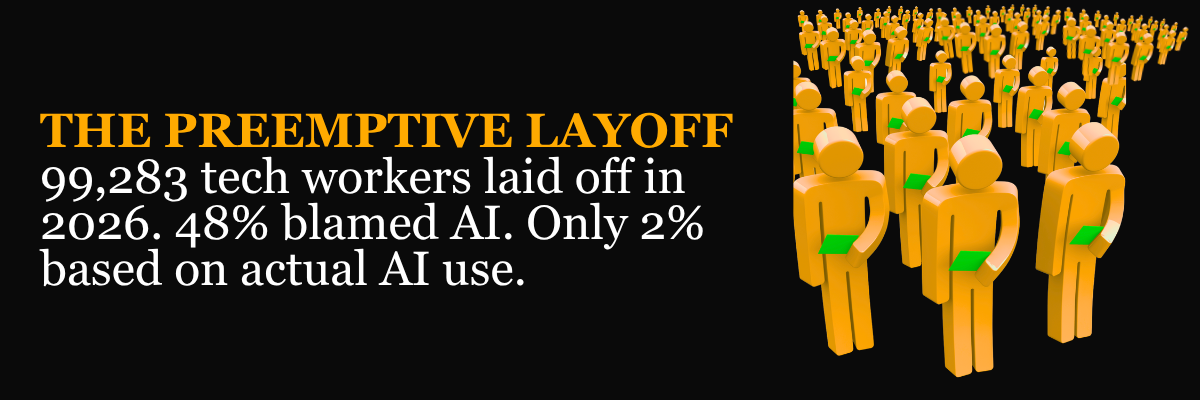
Since January 2026, 99,283 tech workers have lost their jobs.1 Nearly half of those cuts were attributed to AI.2 But when researchers asked executives why they actually made the cuts, only 2% said the decision was based on proven AI implementation.3 The other 98% fired people based on what AI might do. Someday. Eventually.
This is the preemptive layoff. Not a response to technology that works. A bet on technology that might. Companies are making permanent staffing decisions based on AI's potential, not its performance. They are firing on vibes.
The Survey
In December 2025, Thomas Davenport of Babson College and Laks Srinivasan of the Return on AI Institute surveyed 1,006 global executives about their AI-related workforce decisions. The results, published in Harvard Business Review in January 2026, are the clearest picture we have of what is actually driving the cuts.3
60% of executives said they had reduced headcount in anticipation of AI capabilities. Not in response to AI performing specific tasks. In anticipation. Another 29% said they had simply hired fewer people. Only 2% said their workforce reductions were based on actual AI implementation and demonstrated results.
Read that again. Sixty percent of executives cut staff because they believed AI would eventually be able to do the work. Two percent cut staff because AI was actually doing the work. The gap between those two numbers is the size of the problem.
This is not a technology story. This is a decision-making story. The largest workforce reduction in tech history is being driven not by evidence but by expectation. The layoffs are a forecast disguised as an optimization.
That is not a rounding error. That is a policy failure.
The Case Studies
Klarna: The Poster Child
In 2024, Klarna CEO Sebastian Siemiatkowski became the face of the AI layoff. The company cut roughly 700 employees, replacing customer service workers with AI chatbots. Siemiatkowski boasted publicly about the results. AI was doing the work of 700 people. Headcount was down. Efficiency was up.
Then customer satisfaction deteriorated. Service quality dropped. By early 2026, Siemiatkowski admitted the company had "gone too far" and announced Klarna was rehiring human workers.4 The company that cut 700 jobs for AI is now hiring people back because the AI could not actually do the jobs.
Klarna is not an edge case. Klarna is what happens when the 60% catches up to reality.
Salesforce: The Math That Doesn't Add Up
Marc Benioff declared that Salesforce would hire zero new software engineers for fiscal year 2026. The company has roughly 15,000 engineers. The stated reason: AI productivity gains made new hires unnecessary.5
But the actual productivity gain Benioff cited was 30%. His words: "our engineering organization's probably 30% more productive, but I wouldn't call it 100% more productive."5 Meaningful, but not transformational. Not "we never need another engineer." And while Benioff froze engineering hiring, Salesforce hired 20% more sales staff. The company's AI revenue hit $2.9 billion, with $800 million from Agentforce alone.
So the AI is generating billions in new revenue. The company is hiring aggressively in sales to capture that revenue. But the engineers who build and maintain the AI products? Frozen. The message: AI is valuable enough to sell but not valuable enough to staff.
Duolingo: The Two-Tier Layoff
In early 2026, Duolingo announced it was going "AI-first." CEO Luis von Ahn said the company would stop using contractors for work that AI could handle. Contractors were let go. Full-time employees were kept.6
Von Ahn was careful with his language: "We have never done a layoff" of full-time employees. Technically true. The contractors who lost their income might quibble with the framing. This is the two-tier layoff. If you are full-time, you are part of the AI-first future. If you are a contractor, you are the part AI replaced. The distinction is not about capability. It is about classification.
Block: The Convenient Excuse
Jack Dorsey cut roughly half of Block's workforce and attributed the reductions to AI. The narrative was familiar: AI can do more with less, so we need less.7
But analysts at Salesforce Ben raised a sharper question: were the cuts really about AI, or was AI the cover story for financial underperformance?7 Block had been struggling. Revenue growth had slowed. The AI framing let leadership repackage cost cuts as strategic transformation. Layoffs motivated by a balance sheet sound like failure. Layoffs motivated by AI sound like vision.
Forrester gave this a name: "AI-washing." Attributing financially motivated workforce reductions to AI strategy. It lets companies frame defensive cuts as offensive moves. The stock price responds better to "we're leaning into AI" than "we missed our numbers."8
The Junior Pipeline
The preemptive layoff does not fall equally. Entry-level hiring in tech has collapsed by 73%.9 Computer science graduates now face 6.1% unemployment, nearly double the national average of 3.6%.9 Job postings for junior developers are down 40% from pre-2022 levels.
The logic is circular. Companies say AI can handle junior-level tasks, so they do not hire juniors. But the juniors they are not hiring have never had the chance to prove that AI cannot do their jobs. They are being eliminated from a comparison they were never part of.
And without juniors, there are no future seniors. The pipeline that produces the experienced engineers companies depend on is being cut at the intake. Every company that skips a year of junior hiring is borrowing experience from a future that will not have it.
You can only defer the consequences of not having one.
The Regret
Forrester found one more number that matters: 55% of employers who made AI-motivated workforce cuts now regret them.8
More than half. They cut headcount in anticipation of AI. The AI did not deliver what they anticipated. Now they regret it. Klarna is the most visible example, but the pattern is widespread. Companies that moved fast on AI layoffs are quietly walking them back. Rehiring. Backfilling. Discovering that the tasks they assumed AI would handle still require people.
The regret is not surprising. The 60/2 gap predicted it. When you make irreversible decisions based on potential rather than performance, you should expect to be wrong most of the time. The only surprise is how quickly the regret arrived. These cuts are less than a year old and already more than half of the people who made them wish they hadn't.
The Gap
Gary Marcus, writing in Fortune, laid out the numbers plainly: AI currently covers less than 4.5% of internet-based jobs.10 Not 45%. Not 14.5%. Four and a half percent. The gap between the jobs AI can demonstrably do and the jobs companies are cutting is enormous.
Anthropic's own research acknowledged what they called a "comically small fraction" between AI's potential coverage of tasks and its observed real-world coverage.10 The company building the AI is telling you the capability curve has not materialized at the scale the layoffs assume.
On the ground, the evidence is consistent. 75% of consumers report frustration with AI customer service.4 Only 11% of companies have AI in production at meaningful scale. The rest are piloting, experimenting, or planning. They are in the anticipation phase. And they are laying people off as though they were in the implementation phase.
The capability curve these layoffs are predicated on has not arrived. It may arrive. It may arrive in five years, or ten, or in a form nobody predicted. But the layoffs are happening now. The junior pipeline is being cut now. The institutional knowledge is walking out the door now. And 55% of the executives who ordered it already wish they hadn't.
Vibe-Based HR
There is a term in software development: vibe coding. Writing code based on intuition rather than specification. Fast, loose, and untested. It works until it doesn't, and when it doesn't, the failures are hard to trace because nobody wrote down the assumptions.
This is vibe-based HR. Companies are making irreversible decisions about their workforce based on the same kind of thinking that produces vibe-coded software. Fast, intuitive, and untested. The assumptions are not written down. The evidence is not gathered. The decision is made on a feeling about the future.
The difference is that you can revert bad code. You can roll back a deploy. You can hotfix a production bug at 2 a.m.
You cannot revert a gutted junior pipeline. You cannot hotfix a demoralized workforce. You cannot roll back the institutional knowledge that left when you laid off the people who held it.
Some of these companies will rehire. Klarna already is. But the people they hire back will not be the same ones they let go. Those people found other jobs, left the industry, or learned a lesson about loyalty that no signing bonus will undo. The new hires will start from zero, without the context, the relationships, or the institutional memory that the company spent years building and one quarter destroying.
Ninety-nine thousand, two hundred and eighty-three people. Forty-eight percent blamed on AI. Two percent based on evidence. The rest was vibes.
Disclosure
This article was written with the assistance of Claude, an AI made by Anthropic. Yes, that Anthropic, whose own research is cited above acknowledging the gap between AI potential and AI reality. We reviewed every claim, checked every number, and verified every source. Corrections welcome at bustah_oa@sloppish.com.
Sources
- SkillSyncer, "Tech Layoffs 2026 Tracker." 99,283 tech workers laid off as of April 2026. Link. See also Tom's Hardware, "Over 80,000 tech workers laid off in 2026 so far." Link.
- Multiple industry trackers report approximately 48% of 2026 tech layoffs attributed to AI-related restructuring. Compiled from layoffs.fyi and company announcements.
- Thomas Davenport and Laks Srinivasan, "AI Isn't Ready to Replace Most Jobs, but Companies Are Cutting Headcount Anyway," Harvard Business Review, January 2026. Survey of 1,006 global executives conducted December 2025. Link.
- Klarna CEO Sebastian Siemiatkowski admitting the company "went too far" with AI-driven cuts and announcing rehiring. Covered by Fast Company, Reworked, and Entrepreneur.
- Marc Benioff on Salesforce engineering hiring freeze and 30% productivity gain, FY2026. Startup Fortune. Hiring freeze confirmed by LatestLY.
- Duolingo "AI-first" strategy and contractor reductions. Luis von Ahn comments. Fortune. See also TechCrunch.
- Block/Jack Dorsey workforce reductions attributed to AI. "Can we finally admit AI layoffs are about cost-cutting, not capability?" Salesforce Ben.
- Forrester Research: 55% of employers regret AI-driven layoffs. Coined "AI-washing" for attributing financially motivated cuts to AI strategy. HR Executive. See also Salesforce Ben.
- Entry-level tech hiring collapse. ThinkPol and ByteIota report 67-73% decline in junior developer hiring. CS graduate unemployment at 6.1% vs. 3.6% national average. ByteIota. See also ThinkPol.
- Gary Marcus, "9 Reasons AI Isn't Going to Take Your Job Anytime Soon," Fortune, 2026. Includes Anthropic research on gap between potential and observed AI task coverage. Link.